Design 54
In Johannesburg, Clout/SA and Proportion Design Studio have assembled the work of more than 20 South African designers, artists and makers into a single leadership space. The result is more than an interior project; it is an argument for what contemporary South African design is, can be and for the cultural and economic systems needed to sustain it.
There is a persistent tendency, particularly outside the continent, to speak of African design as though it were a visual category: a collection of patterns, colors, materials and motifs that can be assembled into an instantly recognizable aesthetic. The Isaac Shongwe Room in Johannesburg resists that simplification. Designed by Clout/SA in collaboration with Proportion Design Studio, the multi-purpose conferencing and leadership space brings together the work of more than 20 South African designers, artists and makers without asking any one object to stand in for a nation. Instead, identity emerges through accumulation. Embroidery, cork, beadwork, ceramics, wool, furniture, lighting and contemporary art inhabit the room together, each carrying its own authorship, material history and relationship to place. What results is not a prescribed vision of “South African style”, but something more nuanced: a room built through many voices.
The project was recently recognized at the inaugural African Interior Design Awards(AIDA) 2026 in Cotonou, Benin, where it was one of three Clout/SA projects to receive honors. Union House was recognized in the Office Interior Design category, while Stitched: A Story of Our Home, Clout/SA’s collaboration with the Keiskamma Art Project, was named Product of the Year in Homeware an Decoration category. For Tracy Lynch, Executive Creative Director of Clout/SA, the significance of the awards lay as much in the platform itself as in winning.
“I just loved the fact that it’s an awards platform from Africa to the world,” she tells Design233.
The distinction is important to her. Too often, African design is framed through the act of being discovered, validated or selected elsewhere. A platform that begins from within the continent changes the direction of that gaze. It allows African architecture, interiors and product design to be discussed first on their own terms, with their own questions, histories and priorities.
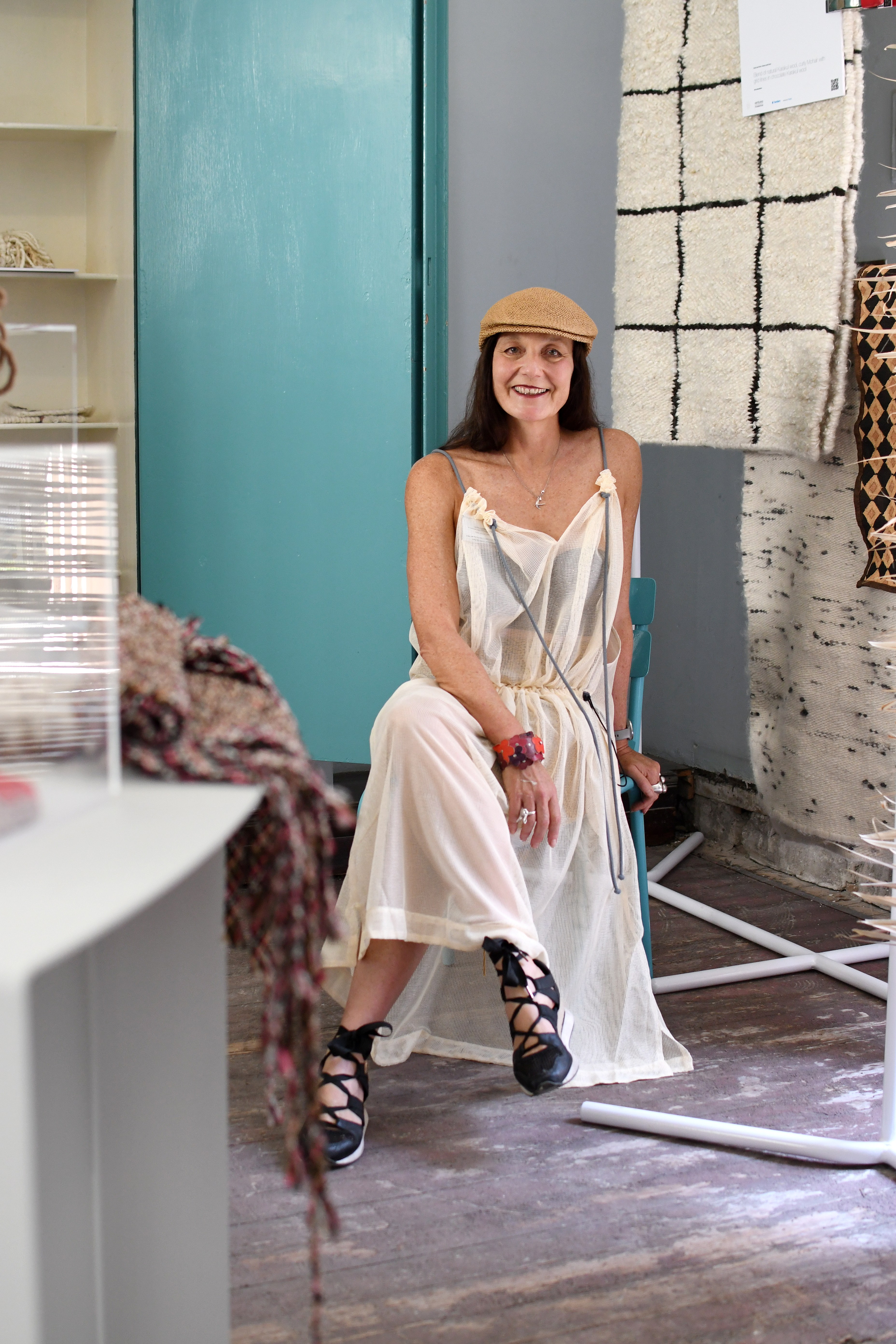
Photography: Greg Cox; Stylist, Creative Director: Tracy Lynch, Clout/SA. Courtesy of Clout/SA
Clout/SA’s story is inseparable from the larger creative ecosystem built around Nando’s, the South African restaurant brand under whose broader group structure the design platform developed. Long before Clout/SA formalized its mission around contemporary South African design, Nando’s had become one of the country’s most consequential corporate patrons of contemporary art, amassing an extensive private collection of over 25,000 pieces of work by Southern African artists and placing that work throughout its restaurants internationally. The collection is managed in partnership with the Cape Town-based Spier Arts Trust, an art consultancy and trust that works across collecting, curation and artist development. Through initiatives such as Creative Block, artists are able to produce smaller works for regular curatorial review and immediate purchase, while receiving feedback and opportunities to grow within a wider professional network. Over time, artists emerging through this ecosystem have progressed to larger commissions, exhibitions and international exposure. It is a model in which collecting is not simply the acquisition of finished work, but part of a longer infrastructure of patronage, mentorship and market access.
Lynch, whose own background is in fine art, was already familiar with this system when she became involved in the creative direction of Nando’s Johannesburg headquarters. What struck her was that while the company had developed a sophisticated mechanism for supporting and circulating South African art, there was not yet an equivalent structure around contemporary South African furniture, lighting and product design. That gap would become the germ of what eventually developed into Clout/SA.
When asked what she thought of the restaurants at the time, Lynch’s response was pointed: they appeared to her like spaces created by people without an intimate understanding of South Africa and its aesthetic cultures. When asked what she would do differently, she proposed something that would eventually become the basis of Clout/SA’s approach: she would curate rather than simply decorate. “You bring in the voices of many,” she recalls.
That idea became central to the redesign of Nando’s Central Kitchen in Johannesburg, where she assembled work from more than 50 South African designer-makers across furniture, lighting, tables, servers and other interior elements. When designers working on Nando’s restaurants internationally visited the space, they encountered not a singular aesthetic formula but a dense, contemporary expression of South African making. The question quickly shifted from What does South African design look like? to Where can we get it?
A catalogue followed, then an online marketplace, Portal to Africa, through which designers working on Nando’s restaurants internationally could source South African products. Clout/SA subsequently expanded beyond that original client, taking on commercial interiors and other commissions while retaining the same basic proposition: that interior space could become a vehicle for cultural visibility, economic opportunity and design authorship.
Photography: Greg Cox; Stylist, Creative Director: Tracy Lynch, Clout/SA. Courtesy of Clout/SA
The Isaac Shongwe Room is perhaps one of the clearest distillations of that thinking. Located at The Pines in Johannesburg, the room was commissioned by Taro Park, the clients, as a flexible environment for leadership teams, government partners and other stakeholders—a place, as Lynch puts it, to “gather and have conversations and make big plans.” The pragmatic brief called for a space capable of shifting between different meeting formats, with mobile furniture, fixed seating and a catering area that could disappear when not in use. Yet the deeper ambition was to create a room in which South African art, craft and design were not embellishments applied after the architecture had been resolved, but the primary language through which the space would be experienced.
Working with interior architect Tuami Zulu of Proportion Design Studio, Clout/SA organized the room around a flexible central meeting area, perimeter seating zones and a deli kitchen. But it is material, rather than plan, that gives the interior its emotional register. On entering, the eye is drawn almost immediately to The Resilience Piece, a monumental embroidered hanging by the Keiskamma Art Project that occupies an entire wall. Created by approximately 12 artists over nearly a year, the work records the experiences of a rural Eastern Cape community during the Covid-19 pandemic—its losses, interruptions, endurance and response—through thread. Keiskamma, based in the coastal village of Hamburg, has spent more than two decades using embroidery as both artistic practice and social instrument. Its works are at once community record, cultural testimony and source of livelihood. Within the Isaac Shongwe Room, The Resilience Piece does not function like conventional corporateart. It carries too much narrative weight for that. Its scale and subject transform the wall into something closer to an archive. Lynch describes it as the work that “pulls that whole room together,” and it does so not because it coordinates with the palette, but because it establishes the room’s underlying premise: that contemporary interiors can accommodate memory as well as beauty.
Around it, the material conversation continues. Rugs designed by Siyanda Mbele and manufactured by Brabetz Carpets introduce bold geometries at floor level, their compositions revealed and obscured as furniture is rearranged. Custom cork panels by Wiid Design wrap portions of the walls and ceiling, lending acoustic softness while giving the space a rich, sculptural surface. Near the catering area, handmade beaded screens and tiled elements by Kalki Design Studio move the language of craft into architectural scale, while servers occupy the territory between utility and collectible design. Suspended over the central meeting area is a beaded linear pendant by Mash.T Design Studio, founded by Thabisa Mjo, whose trajectory offers a compelling example of how access, mentorship and opportunity can help turn emerging talent into an internationally recognized practice.
Mjo was the first winner of Clout/SA’s Hot Young Designer program, entering with her now well-known Tutu Light. Her work has since become highly sought after internationally and has been exhibited and collected by major cultural institutions, including the Musée des Arts Décoratifs in the Louvre complex in Paris. She was also selected by Dolce & Gabbana as one of a group ofleading young global designers to watch, bringing her work into yet anotherinternational design context.
Lynch is careful not to claim Mjo’s subsequent success as Clout/SA’s achievement.“…that’s obviously not because of us,” she says, but describes the platform as having helped “plant a seed.”
It is an important qualification. The value of an ecosystem is not that it authors the success of those who pass through it, but that it creates conditions in which talent can be recognized, developed and connected to opportunity. Mjo remains one of the platform’s strongest sellers, with her lighting reaching clients well beyond South Africa.
Photography: Greg Cox; Stylist, Creative Director: Tracy Lynch, Clout/SA. Courtesy of Clout/SA
That distinction between visibility and infrastructure is central to understanding Clout/SA’s significance. African designers are hardly lacking in creativity, and international interest in African art, architecture and product design has grown considerably. The more difficult question is what happens after attention arrives. Furniture requires prototypes, production capacity and quality control. Export requires logistics. Product development requires capital. Intellectual property must be protected. Craft traditions need to create viable livelihoods if they are to continue. Recognition alone does not resolve any of these conditions. Lynch speaks openly about the historical inequalities that have shaped access to South Africa’s design economy, particularly the financial barriers involved in moving from an idea to a consistently manufactured product. “Black designers are still not given enough opportunity in our country,” she says. “We are committed to changing the status quo and doing our best to create a ripple effect.” Clout/SA’s mentorship program, marketplaces and commissioning structures therefore attempt to address both sides of the equation: cultural recognition and commercial viability.
Its Hot Young Designer program, for example, introduces participants to the business of design while supporting the prototyping and development of selected products. Once a piece reaches sufficient quality and production consistency, it can enter a marketplace where actual buyers already exist. Clout/SA has also developed a pattern library that allows fashion designers, graphic designers, illustrators and other creatives to license contemporary pattern work for furniture, architectural applications and interiors. Each use generates a licensing fee. It is a seemingly small mechanism, but it directly confronts a much larger problem: the habitual extraction of African visual languages from their authors. Patterns originating in African cultural and craft traditions have long circulated internationally after being stripped of place, maker and attribution, reduced to generic descriptors such as “tribal” or“ African-inspired”. Clout/SA’s model instead insists on identifiable authorship and economic participation. The aim is not simply to place African-looking objects into global interiors, but to ensure that the people producing new African design languages remain attached to the value those languages generate.
This question of authorship also makes the Isaac Shongwe Room particularly compelling. Nothing in the space needs to perform a caricature of Africanness. Its identity emerges precisely because the work is specific. The beadwork is made by named designers and makers. The embroidery belongs to a particular community and records a particular history. The rugs, lighting, furniture and ceramics have identifiable authors. Here, the contemporary and the inherited are not opposing categories. South African design is allowed to move between industrial design, hand production, sophisticated fabrication and long-established craft knowledge without resolving those conditions into a single style. Lynch describes contemporary South African design as an opportunity for designers “to delve deeper into aspects of identity; to resurrect and amplify the crafted poetry of our past” and, through doing so, to imagine the future differently. The strongest work in the Isaac Shongwe Room achieves precisely this: it neither freezes craft in tradition nor uses it as an exotic surface. Instead, making becomes active, contemporary and capable of migration into new typologies.
The room also suggests that the conventional boundaries between architecture, interior design, art and craft may be less useful than the relationships between them. Furniture by Dokter and Misses sits alongside work by Naturalis; Wiid Design’s cork surfaces converse with Kalki's beadwork; Mash.T’s lighting hangs above Siyanda Mbele’s carpets; additional works curated by the Spier Arts Trust extend the artistic narrative; and outdoor furniture by Douglas and Douglas, The Urbanative and Hope Outdoor Furniture continues the design language beyond the room itself. More than 20 contributors collectively shape the experience. No single piece is burdened with representing South Africa. Together, they construct a far richer portrait.

This collaborative density may also explain why the project feels significant beyond its immediate program. It arrives at a moment when South Africa’s contemporary design sector is rapidly expanding, even as Lynch describes it as comparatively young. South Africans have, of course, made extraordinary objects for generations; what is relatively recent is the infrastructure of contemporary furniture and product design—formal studios, manufacturers, marketplaces, fairs, export networks and design institutions capable of moving that work through a global economy. Lynch points to the growth of Cape Town Furniture Week, from a modest cluster of venues only a few years ago to a city-wide event involving dozens of spaces, as evidence of a sector finding both confidence and critical mass. Yet she is clear that substantial work remains.
Perhaps this is why the Isaac Shongwe Room is most interesting not as a showcase of successful objects, but as a model of what can happen when creative work is supported by systems. It is, on one level, an elegant conferencing space. On another, it is a network made visible: designers, embroiderers, manufacturers, artists, curators, interior architects, craftspeople and commercial clients all intersect within one room. The result demonstrates that contemporary African design need not be translated into a more familiar international language in order to appear sophisticated, relevant or globally legible. Nor must cultural specificity be sacrificed in the pursuit of modernity.
A wall of embroidery can carry the emotional weight of architecture. Beadwork can become light. Cork can become acoustic landscape. A meeting room can become a cultural archive. And a commercial interior can become part of a much larger project: building an economy in which African designers, artists and makers are not only seen, but named, paid, protected and given the opportunity to grow.
That may ultimately be Clout/SA’s strongest argument. The future of African design will not depend simply on persuading the world to recognize African creativity. It will depend on constructing the structures through which African creatives can define its value, retain its authorship and carry it into the world on their own terms.
‘Isaac Shongwe’ Boutique Conferencing Centre, The Pines, Johannesburg:
- Creative direction,interior design and procurement: Clout/SA
- Collaborating interior designer: Proportion | Interior Architecture SA Studio
- Carpets: Siyanda Mbele
- Occasional chairs andside tables: Dokter and Misses
- Cork ceiling panels andcork side table: Wiid Design
- Lighting pieces: MashT
- Sofas: Dokter andMisses
- Kitchen, servers and screens: Kalki Design studio
- Chairs: Naturalis
- Cork ceiling and wallpanels: Wiid Design
- Planters: Plantr
- Keiskamma Arts Trustcreated the giant embroidery, titled, ‘The Resilience piece’, the story ofCovid and the response of a rural village in the Eastern Cape, South Africa, astold by the artists and embroiderers of the Keiskamma Arts Trust
- Additional art curated:Spier Arts Trust
- Outdoor furniture: Douglasand Douglas, The Urbanative and Hope Outdoor Furniture
Credits


related articles


Architecture, Art, and Design of Africa and the African Diaspora. We seek out African creatives who instigate positive change through design and art.


